

 Date: 2026-7-23 Click:248 times
Tablets are one of the most common dosage forms in the health supplement industry. However, different manufacturing processes can have a significant impact on the quality of the final product—especially the stability of active ingredients. Currently, the two major tablet manufacturing processes are powder direct compression and wet granulation compression. From an OEM/contract manufacturing perspective, this article provides an objective comparison of the process differences, effects on ingredient stability, and applicable scenarios, helping brand owners select the most suitable technology based on their product needs.
I. Powder Direct Compression: Simplified Process with Better Ingredient Protection
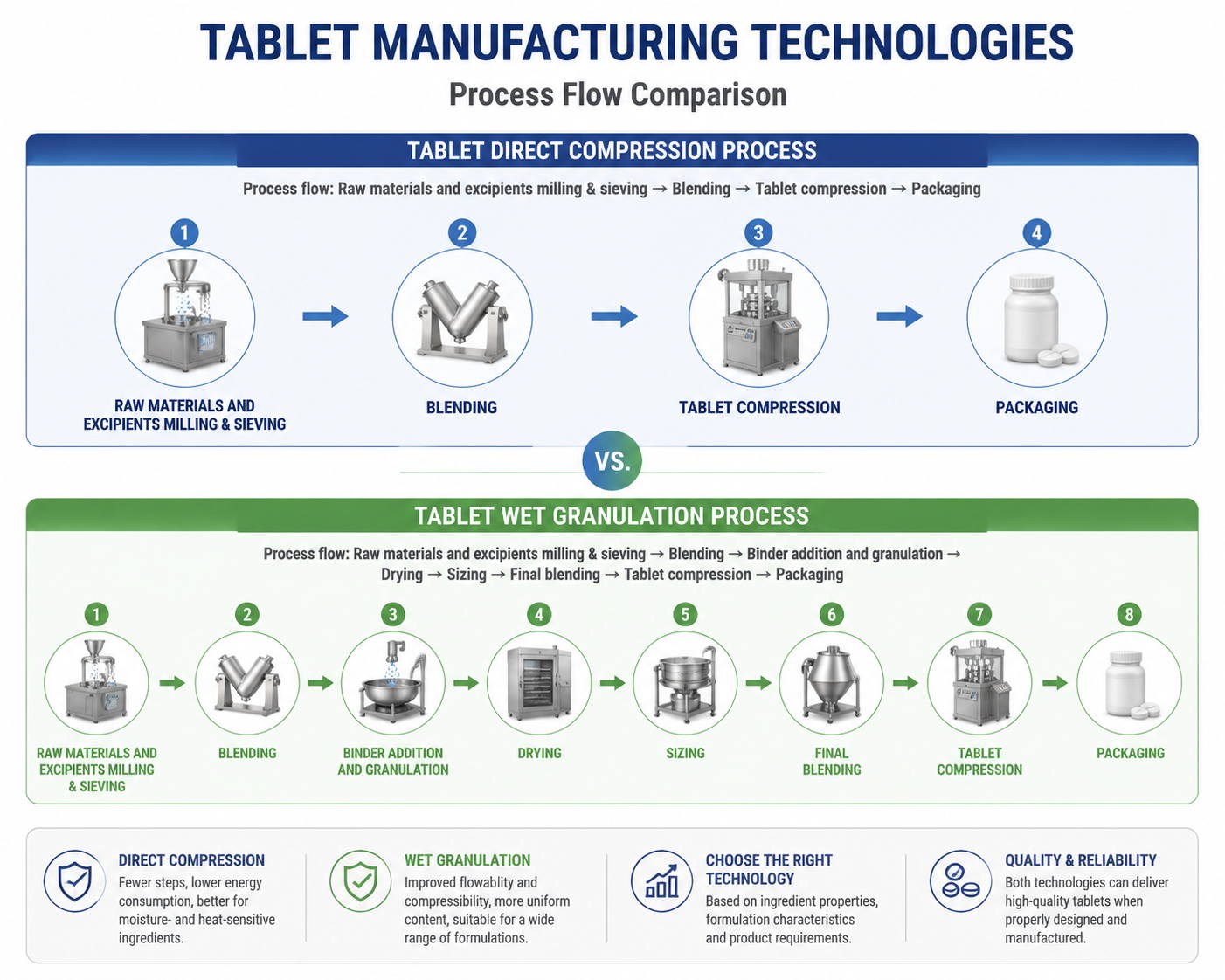
Powder direct compression refers to the process of mixing raw material powders with suitable excipients after sieving, without any granulation step, and directly compressing the mixture into tablets. The process is highly streamlined:
Raw material and excipient milling & sieving → Blending → Tablet compression → Packaging
The key advantage of direct compression is that it does not involve moisture or high temperatures throughout the entire process. Wet granulation requires steps such as liquid binder addition, wetting, and high-temperature drying, which may cause moisture- and heat-sensitive active ingredients to degrade, oxidize, or lose potency. In contrast, direct compression is carried out under dry and room-temperature conditions, allowing maximum preservation of ingredient stability and activity.
In addition, direct compression eliminates the need for binders and drying procedures, reducing overall energy consumption by approximately 30%–50%, making it more aligned with green manufacturing principles. The shorter process flow and reduced processing time also help minimize the risk of cross-contamination.
However, direct compression places higher requirements on the flowability and compressibility of raw materials. Since fine powders generally have poorer flow properties than granules, uneven feeding may occur during compression, resulting in tablet weight variation. Meanwhile, differences in density between raw materials and excipients may lead to powder segregation during compression, affecting content uniformity. Excipients suitable for direct compression are often specially processed materials, which may increase formulation costs.
II. Wet Granulation: Strong Adaptability with Mature and Stable Processing
Wet granulation is one of the most widely used tablet manufacturing processes. The typical process includes:
Raw material and excipient milling & sieving → Blending → Binder addition and granulation → Drying → Sizing → Final blending → Tablet compression → Packaging
The key advantage of wet granulation lies in its strong adaptability to different raw materials. For ingredients with poor flowability or insufficient compressibility, granulation can significantly improve their powder properties, resulting in more stable and controllable tablet quality.
After granulation, the material has much better flowability compared with fine powders, ensuring smoother and more consistent tablet compression. Content uniformity is also easier to control. In addition, wet granulation is a well-established technology with highly versatile equipment, making it suitable for a wide range of formulation systems.
However, wet granulation also has certain limitations. During the process, materials are exposed to solvents from binders and undergo high-temperature drying, which may cause degradation of moisture- and heat-sensitive active ingredients. Some studies have shown that certain degradation products may be present at higher levels in wet-granulated samples compared with directly compressed tablets, indicating that moisture and heat can accelerate the degradation of certain ingredients.
Furthermore, wet granulation involves more processing steps and a longer production cycle, resulting in higher equipment investment, energy consumption, and manufacturing costs.
III. Comparison of Application Scenarios Between the Two Processes
|
Category |
Powder Direct Compression |
Wet Granulation |
|
Active ingredient protection |
No exposure to moisture or heat, better suited for heat-sensitive ingredients such as vitamin C and peptides |
Potential degradation risks due to moisture and high-temperature drying |
|
Process complexity |
Simple process involving mainly blending and compression |
Requires multiple steps including granulation, drying, and sizing |
|
Material flowability |
Requires good raw material flow properties and specialized excipients |
Granulation significantly improves powder flowability |
|
Content uniformity |
Higher risk of segregation and requires careful formulation design |
Easier to achieve consistent content uniformity |
|
Cost structure |
Lower energy and labor costs, but higher excipient costs |
Higher equipment investment and energy consumption |
IV. Selection Guidelines for OEM/ODM Customers
For products containing moisture- and heat-sensitive ingredients such as vitamin C, probiotics, and peptides, powder direct compression is generally the preferred choice as it can better preserve ingredient activity.
For formulations with poor raw material flowability, low compressibility, complex formulas, or larger tablet specifications, wet granulation provides better production stability and content uniformity.
For products requiring rapid disintegration and release, direct compression often offers advantages due to the relatively loose tablet structure and higher porosity, which can contribute to faster disintegration and dissolution.
As a source manufacturer with 18 years of production experience, we specialize in OEM/ODM customization services for four major dosage forms: softgels, hard capsules, tablets, and powders. With extensive experience in both powder direct compression and wet granulation tablet manufacturing technologies, we can recommend the most suitable production process based on the characteristics of each ingredient.
From formulation development to large-scale production, we provide a comprehensive one-stop solution for global brand partners. Feel free to contact us for cooperation opportunities.